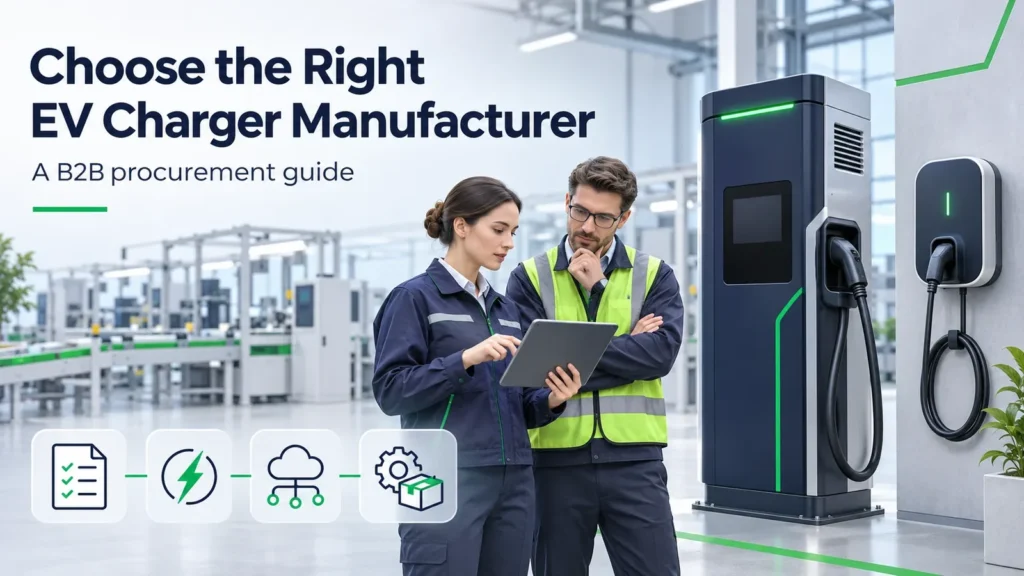
The wrong EV charger manufacturer can delay commissioning or leave you tied to one backend. To reduce those risks, choose a supplier whose proposed equipment meets your market requirements and passes electrical, software, and service checks.
Start with model-specific compliance documents, output curves, and a test on your chosen charging platform. Confirm production traceability, warranty coverage, spare-parts access, and repair responsibilities.
Then compare lifetime costs using the same assumptions. Place the order only after the sample passes written acceptance criteria and the supplier commits to the agreed configuration and support terms.
1. Check certifications and grid compliance first
A charger can arrive with an impressive collection of logos and still lack the documents your project needs. Finding that out after shipment puts the schedule at risk. Match the proposed configuration to the destination market before moving ahead with the supplier.
What UL, CE, CB, and UKCA mean for your purchase
For a US project, establish which certification route the local authority accepts. Common equipment standards include UL 2594 for AC EVSE, UL 2202 for DC charging equipment, and UL 2231 for personnel protection. Installation follows the locally adopted NEC, including Article 625. Canadian requirements need a separate check. UL Solutions’ EV charging guide explains these equipment and installation frameworks.
For EU purchases, ask for the signed EU Declaration of Conformity and supporting documents for the finished charger. CE marking expresses the manufacturer’s responsibility for meeting applicable requirements. Whether a third party must participate depends on the assessment route. The European Commission’s CE guidance explains that responsibility.
The equipment’s configuration determines which safety, EMC, and radio rules apply. Wireless-equipped products need the relevant RED assessment. LVD, EMC, and RED have different scopes. Ask the supplier to explain which apply to the finished configuration and where the supporting evidence sits. See the Commission’s RED guidance.
For Great Britain, CE remains recognized alongside UKCA in relevant electrical, EMC, and radio-equipment sectors. Northern Ireland has separate arrangements, so check the current UK marking table for the intended destination.
For a CB certificate, ask which destination approvals it supports. Verify its identifier with the issuer and match model, configuration, factory scope, and reports to the proposed equipment.
Check how the protection works at your site
An EMC report needs to cover the supplied configuration and intended environment. IEC 61851-21-2:2018 addresses off-board charging EMC. Ask which limits and test conditions apply instead of accepting “commercial Class B” as a complete answer.
For applicable IEC-based Mode 3 AC installations, check the RCD arrangement and protection against DC residual current. A Type B RCD, or an appropriate Type A/F arrangement with a 6 mA RDC-DD, may be relevant. A DC sensor by itself does not establish complete protection. Schneider Electric’s selection guidance explains the arrangements; local rules and the installation design determine the final choice.
For DC chargers, have the designer explain insulation monitoring, fault detection, protective separation, and disconnection for the proposed topology. The review should also cover upstream protection and utility requirements.
2. Find out how much power the charger can deliver
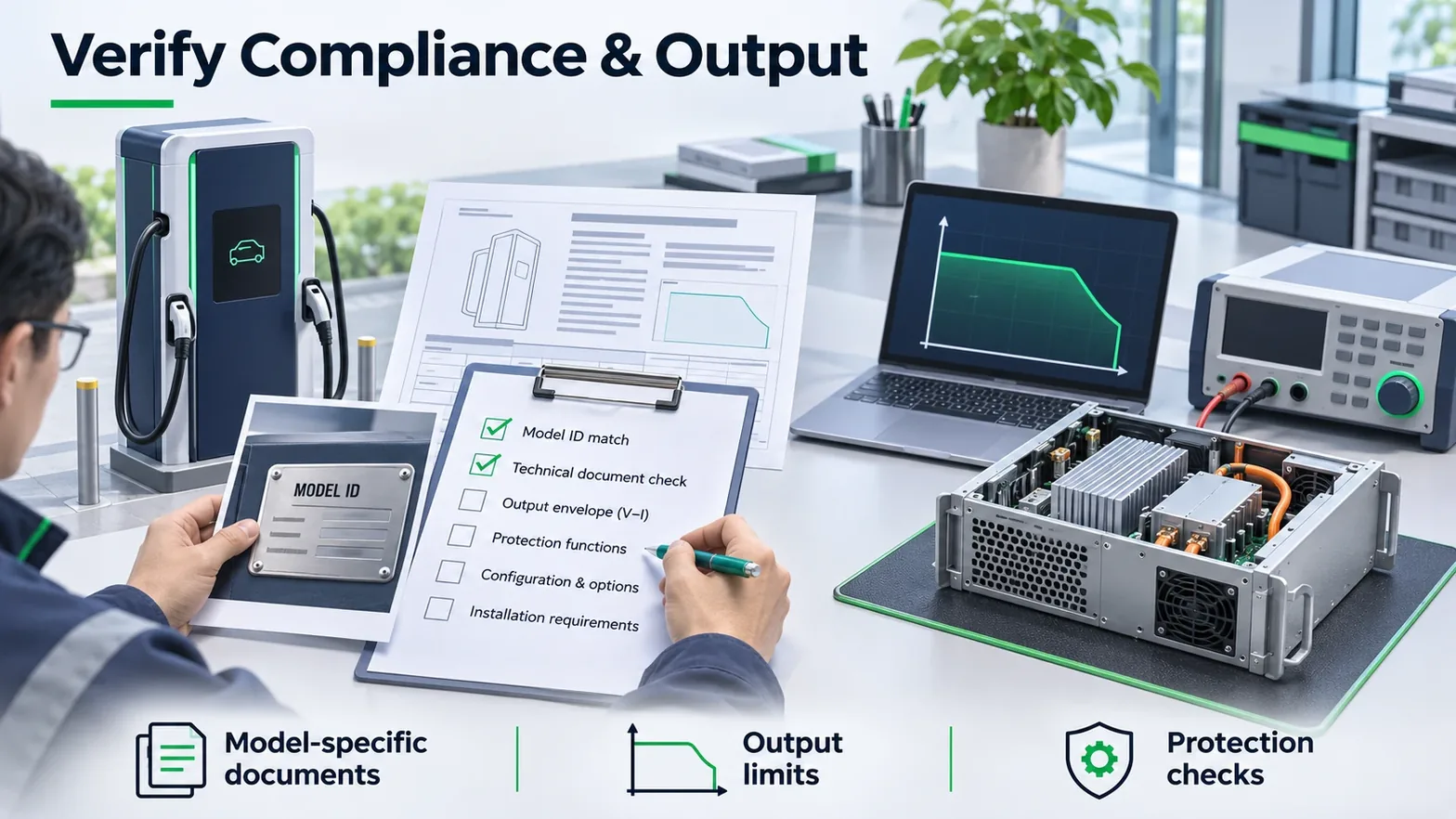
Two cabinets with the same kilowatt rating may deliver different power to the same vehicle. Current limits, temperature, and simultaneous charging can account for the difference. Compare output curves and allocation rules before deciding which electrical architecture fits the site.
Read the output curves, not just the headline rating
Compare DC output-voltage/current limits, efficiency, and temperature derating. Separate cabinet power, per-connector limits, and simultaneous allocation.
For example, an output of 400 V limited to 300 A gives 120 kW. A larger number on the cabinet cannot override that current limit. The vehicle’s charging acceptance, battery condition, and any power sharing can reduce the delivered power further.
SiC technology may help conversion efficiency. Ask for measurements across your expected load and voltage range, including cooling and standby consumption.
Ask what happens when one power module fails. Does the charger continue at reduced output, or does it stop? An N+1 claim needs enough spare conversion capacity and the controls to maintain the contracted output after a failure. Have the supplier demonstrate what happens after a module failure.
EVSETOP’s DC fast charger category provides configurations to shortlist. Request current output curves and simultaneous-allocation tables for the units under consideration.
Look at the parts that affect repairs
Ask for the safety-critical component list and the supplier’s rules for substitutions. Contactors, overcurrent protection, SPDs, meters, cooling equipment, and cables all need ratings suited to their actual duties.
Even with a familiar component brand, check the DC switching and interruption ratings. The site designer also needs to review surge-protection coordination.
Inspect cable entries, drainage, condensation control, and cooling paths alongside the enclosure rating. Open the service panels and check how a technician would replace failed parts.
Compare MTBF only with its calculation method, operating assumptions, and field-data basis.
3. Test software access before you commit
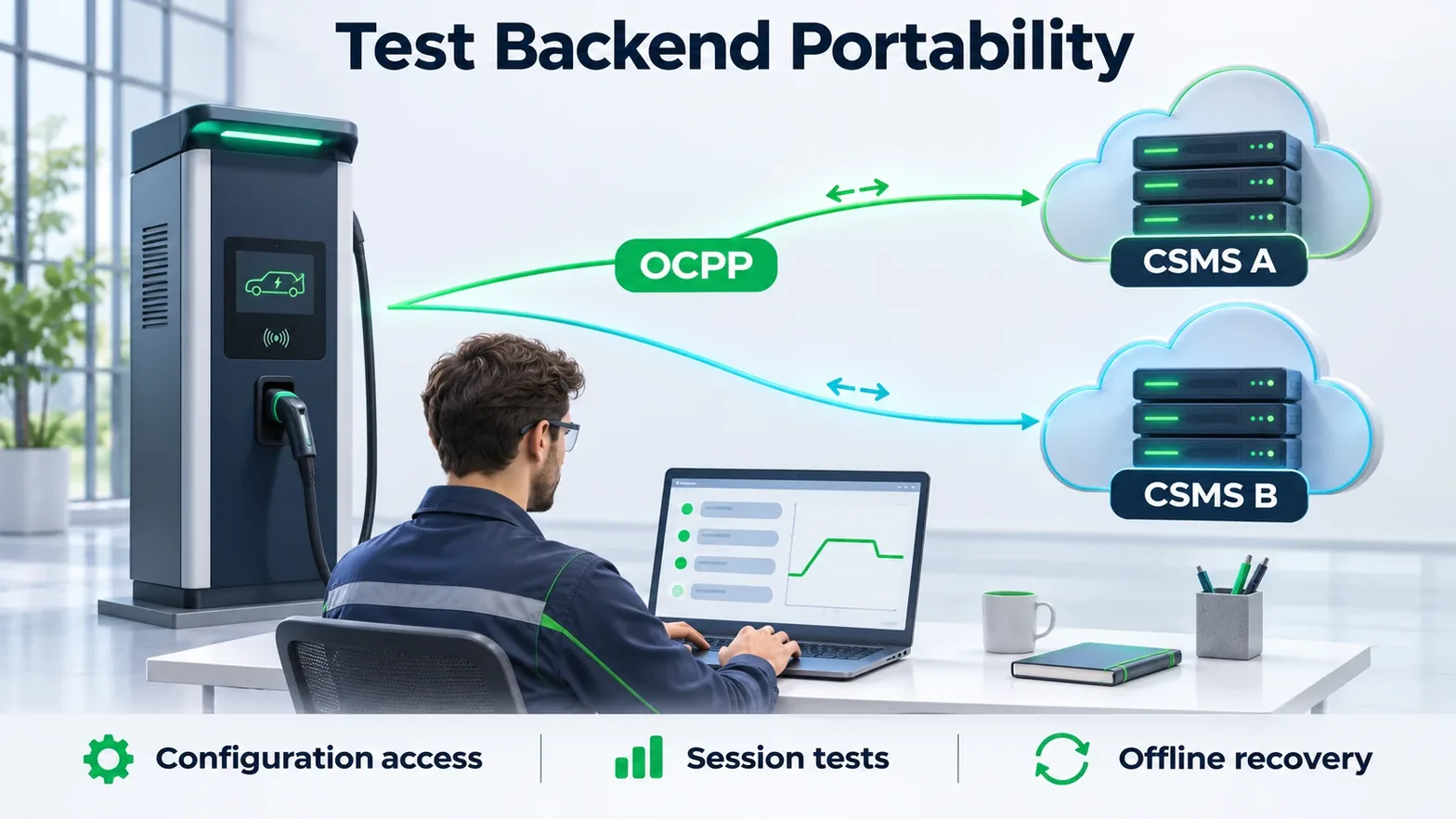
“OCPP supported” leaves an important question open: can you move the charger to another backend and keep the functions you need? Discovering restrictions after deployment makes migration expensive. Include a practical portability test in the supplier evaluation.
OCPP 1.6-J versus OCPP 2.0.1
OCPP handles communication between a charging station and its charging station management system, or CSMS. Open Charge Alliance describes the available versions and their differences.
| Procurement question | OCPP 1.6-J | OCPP 2.0.1 |
|---|---|---|
| Smart charging | Supports charging profiles | Expands smart-charging functionality |
| Device management | Configuration and diagnostics | Adds a structured Device Model |
| Security | Check implementation and security support | Adds integrated security capabilities |
| Compatibility | Needs a compatible implementation | Not backward compatible with 1.6 |
OCPP 2.1 is also available. Choose the version and functions your platform needs. For OCPP 2.0.1 compliance, distinguish the supplier’s own statement from test results and formal certification, including its scope.
During the portability test, change the CSMS endpoint and provision credentials. Run charging authorization, retrieve transactions, apply power limits, and disconnect and restore connectivity. Track any essential function that needs a proprietary extension.
Establish configuration access, data export, and migration costs. Have the operating team try the migration procedure.
Plug & Charge, load management, and solar-storage integration
Specify certificate-based Plug & Charge explicitly. Simple automatic charging activation does not establish that capability. Likewise, bidirectional charging needs compatible power hardware, vehicles, controls, and grid approval. ISO 15118-20:2022 defines communication requirements for bidirectional power transfer; the communication layer is only one part of a working V2G system.
For dynamic load management, check where the meter sits and how the controller responds when other building loads rise. Include phase constraints and loss of internet or sensor data in the test. Cabinet power sharing and site-wide load control solve different problems, so specify both where needed.
For PV and BESS integration, request a diagram showing the EMS, meters, inverter/storage controls, and communication links. Assign responsibility for enforcing the limits. The complete combination needs verification even when the charger supports OCPP.
4. Define what OEM and ODM customization includes
A request for different branding can grow into changes to hardware, approvals, and software support. That creates room for disagreement over costs and responsibility. Define the changes and who will validate them before approving the sample.
Separate branding from engineering changes
A logo or paint change is a different job from replacing a connector, radio module, enclosure, or cooling system. For DC fast charger OEM/ODM work, put the scope in writing:
- Who owns the hardware design, firmware, drawings, and tooling?
- Which screen languages, RFID functions, and payment interfaces must work?
- Who handles any reassessment after a configuration change?
- What must the pilot batch pass before production starts?
A payment terminal that fits the cabinet still needs an integration test. Follow the transaction through authorization, charging start, displayed pricing, failed sessions, and reconciliation.
Make firmware support testable
For API or Modbus integration, document the supported functions and how the supplier tests them.
Firmware acceptance should cover signed delivery, staged rollout, and recovery from an interrupted update. Establish the rollback policy and version records, along with diagnostic access and escalation.
Be precise about response times. A negotiated 48-hour response may mean an acknowledgement, a workaround, or a validated fix. Those are different commitments, and a fix still needs approval before deployment.
5. Check production control and environmental evidence
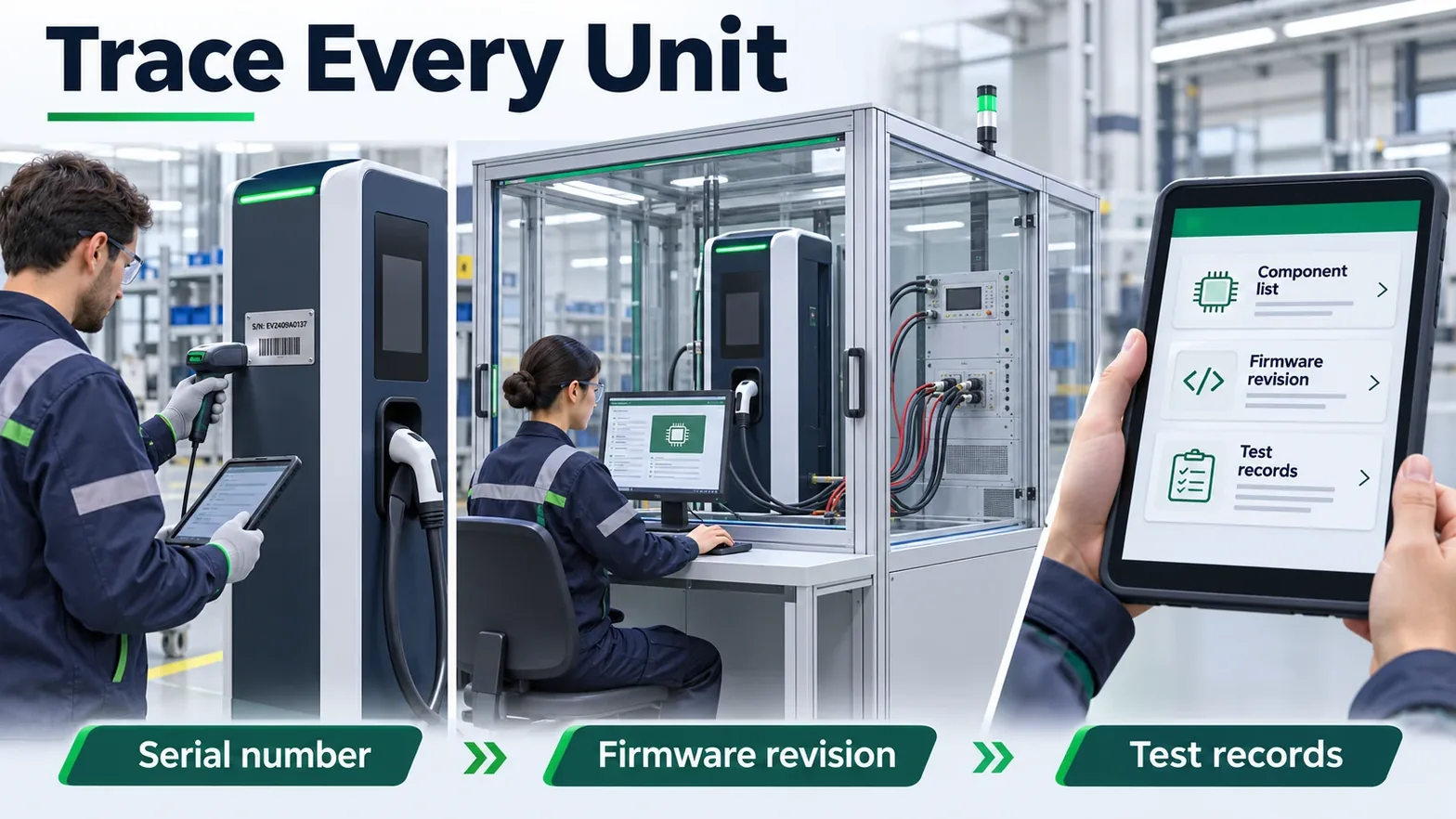
A factory tour shows you the premises; it tells you less about the charger that will arrive. Poor control over parts or testing can delay delivery and leave defects for your maintenance team to find. Follow a unit through its records and review tests that match the site’s conditions.
Trace a unit through production
Find out which processes the supplier carries out and which it outsources. Owning an SMT line is not a prerequisite for a capable charger supplier. Control over design, incoming parts, assembly, testing, and changes deserves closer attention.
Choose a sample serial number and trace its bill of materials, firmware revision, test results, and release record. Ask how the factory contains nonconforming parts and approves component substitutions.
ISO 9001 and ISO 14001 address management systems. They do not certify an individual charger. Check the certificate’s scope and issuing-body records; ISO explains the roles of these systems.
Assess capacity against your product mix and schedule, including test bottlenecks, scarce components, and recovery plans.
Specify the weather conditions that matter
Match environmental reports to the enclosure and cooling arrangement. Define storage, powered operation, cold starting, humidity, altitude, and corrosion conditions separately.
If you require full output at 50°C or a cold start at −30°C, ask for evidence at those conditions. These are example purchasing requirements. An advertised operating range alone doesn’t tell you how much power remains available near its limits.
For a coastal site, review the coating system, fasteners, connectors, filtration, and maintenance plan. Ask what the corrosion test supports and how the supplier relates it to the expected service environment.
Availability deserves an equally careful definition. Measure it at connector level and agree how to count reduced output, failed sessions, and excluded events. In a 365-day year, 99% availability allows 87.6 unavailable hours before exclusions. Decide whether that allowance suits the operation.
6. Compare lifetime costs and service terms
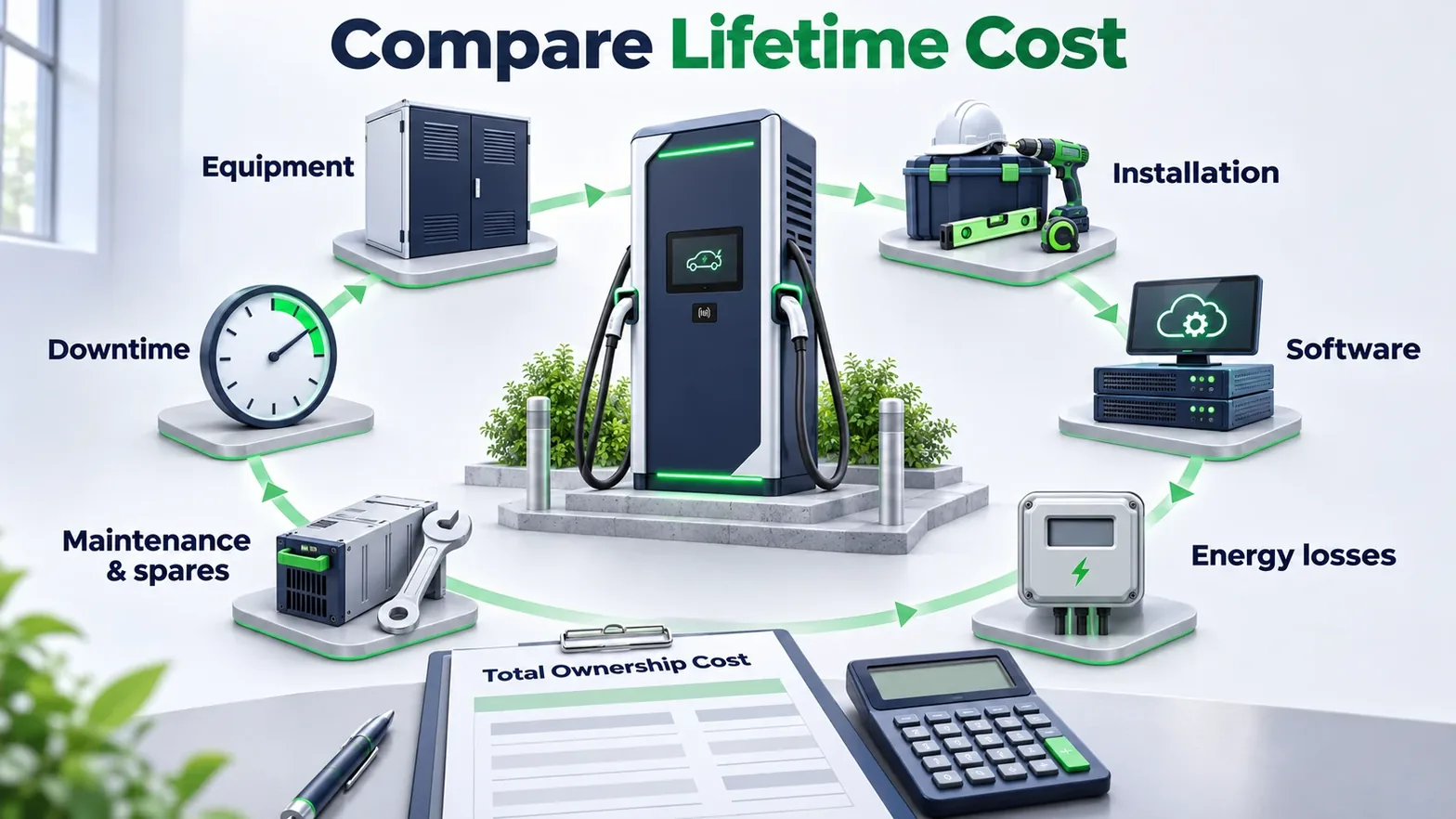
A low purchase price loses its appeal when repairs take weeks or software fees keep growing. Different service scopes can make quotations difficult to compare. Use common cost assumptions and agree how support will work before choosing the cheaper offer.
Build a cost model you can question
Include equipment, freight, duties, compliance work, installation, network upgrades, software, energy losses, maintenance, spares, downtime, and disposal. Where material, account for replacement timing, discounting, and residual value. The share spent on hardware will vary with the site and operating model.
The following five-year example uses hypothetical planning allowances, not supplier quotations:
| Cost item | Option A | Option B |
|---|---|---|
| Equipment allowance | $40,000 | $46,000 |
| Annual maintenance allowance | $2,500 | $1,500 |
| Annual unavailable hours | 150 | 50 |
| Lost contribution per unavailable hour | $20 | $20 |
| Five-year subtotal | $67,500 | $58,500 |
Here, the subtotal adds equipment to five years of maintenance and lost contribution. It excludes installation, energy, software, financing, and other costs. Option B comes out $9,000 lower despite its higher initial allowance.
Vary downtime and utilization assumptions. Investigate further if a small adjustment reverses the result.
Read the warranty alongside the SLA
Warranty periods vary. Compare when coverage starts, which assemblies it includes, and who pays for labor, travel, shipping, and troubleshooting. Replacement turnaround matters as much as the headline number of years.
For cables, contactors, cooling parts, controllers, and power modules, agree on spares availability and replacement arrangements. Include obsolescence notice and access to the documentation needed for maintenance.
An SLA should give separate targets for acknowledgement, diagnosis, workaround, dispatch, and restoration. Assign severity levels and escalation routes. Establish who can attend the site and when. A helpdesk that answers at night may still be unable to arrange a repair until the next working day.
7. Score suppliers after they pass the mandatory checks
A polished presentation can score well while concealing a reason the equipment cannot be used. Averaging that weakness into a total makes the comparison misleading. Hold suppliers at the mandatory checks first, then score those that qualify.
Keep a candidate on hold if market-approval scope remains unresolved, critical protection tests fail, or backend restrictions conflict with your operating requirements.
| Evaluation dimension | Suggested weight | Evidence to score |
|---|---|---|
| Compliance and documentation | 25% | Exact configuration, accepted approval route, report traceability |
| Electrical architecture and build | 25% | Output curves, protection, derating, repairability |
| Software and interoperability | 20% | CSMS tests, migration access, security, update recovery |
| Production and supply continuity | 15% | Traceability, change control, capacity and component plans |
| Service and lifetime cost | 15% | Warranty scope, spares, restoration commitments, TCO |
These are suggested weights for a procurement review. Score each dimension from 0 to 5, then calculate Σ(weight × score ÷ 5) for a total out of 100. Attach evidence to each score. Missing critical evidence keeps the supplier on hold regardless of the total.
Follow document review with sample testing and a site pilot before production release. Match deliveries to the accepted configuration.
For the next stage, compare EVSETOP’s AC wallboxes or shortlisted DC configurations. Discuss the required configuration with EVSETOP using your destination market, vehicle interface, available supply, simultaneous bay count, total/per-port power, backend needs, and required documentation.
Frequently asked questions
Small gaps in a purchase specification can turn into arguments after delivery. Verbal assurances are hard to apply when something goes wrong. Resolve the remaining questions in the specification and acceptance plan before placing the order.
Can an importer or brand owner rely on component CE markings?
The finished charger needs its applicable assessment and declaration, even when its components carry CE markings. A business selling equipment under its own brand may take on manufacturer responsibilities. Confirm the arrangement before approving private-label supply. See EU declaration guidance.
Must every charger be replaced when the backend changes?
Check protocol compatibility, configuration access, credentials, and the functions you need to retain. A migration test on representative equipment helps you establish whether the change needs integration work, different firmware, or replacement hardware.
Which documents should arrive with the chargers?
Agree on the applicable declaration/certification records, configuration identification, installation and operating manuals, maintenance instructions, warranty terms, firmware information, and test records. The documents need to match the delivered units and destination-market requirements.
Is a site pilot worth doing after factory testing?
A pilot lets you test real vehicles, site connectivity, payment flows, building loads, and service access together. Choose its duration and acceptance criteria around representative operating cycles and the failures your team needs to be able to handle.
Conclusion
Choose an EV charger manufacturer through evidence you can check: approvals, usable output, backend portability, production controls, and service terms. Compare lifetime costs under common assumptions. Test the proposed configuration, record what must pass before shipment, and agree who restores service when a charger fails.