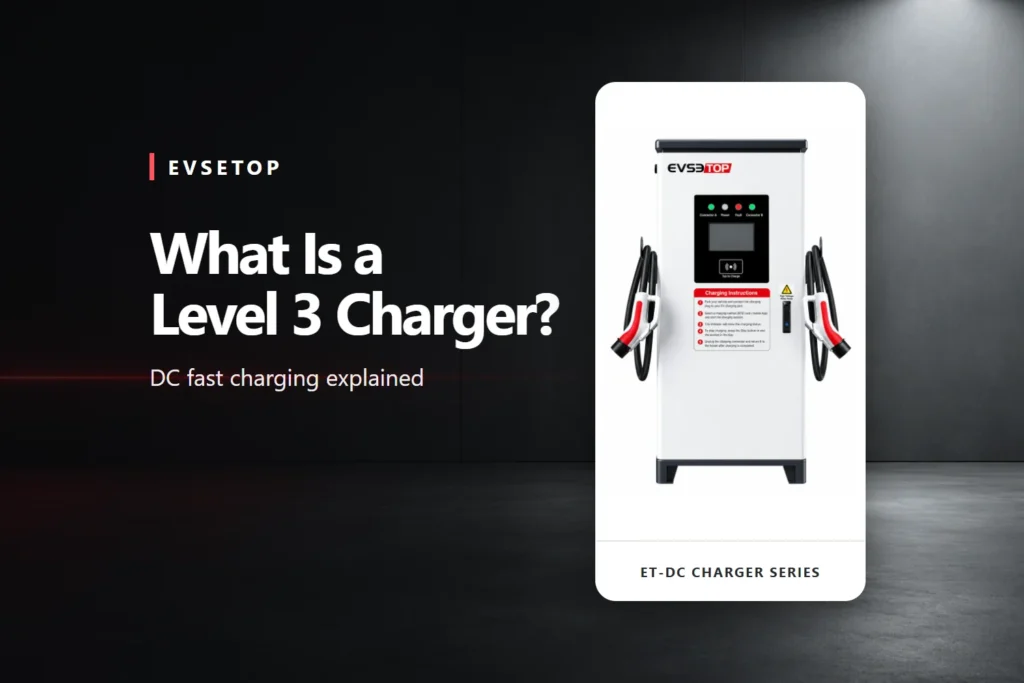
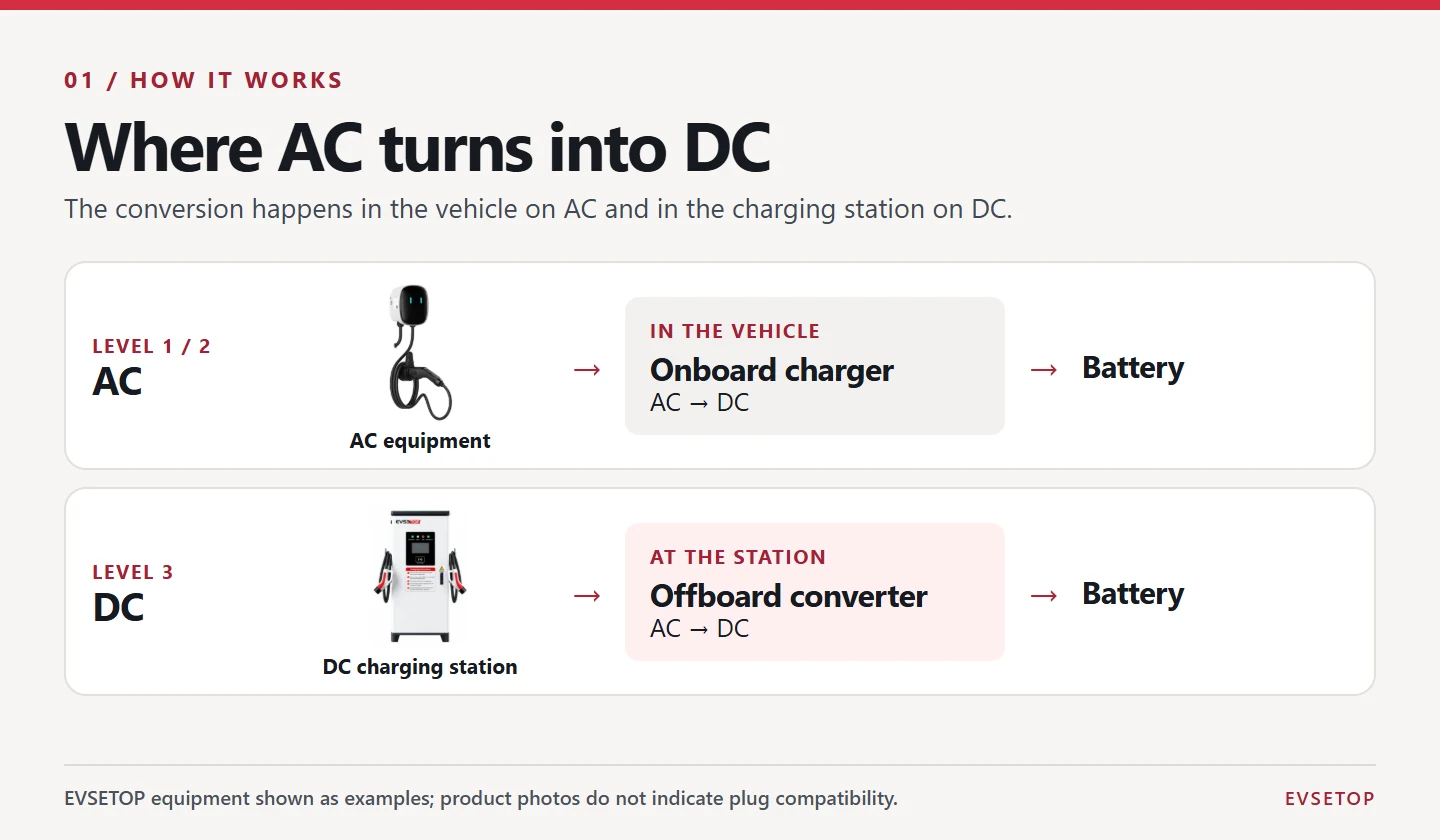
A Level 3 charger is a DC fast charger for electric vehicles. The station converts AC power to DC and sends it to the battery circuit, bypassing the car’s onboard AC charger. Both the station and the car can limit how fast the battery charges.
Say you have 30 minutes at a charger marked 150 kW. To estimate how much energy you’ll get, you need the average power the station can deliver and your car can take during that stop. If you’re choosing a charger for a busy site, find out what each car gets when two plug in at once.
Key takeaways
- Level 1 and Level 2 supply AC to the car. Level 3 supplies DC.
- Use average kW over the charging window to estimate how long a stop will take.
- A plug that fits can still fail to start a session. Check whether the network supports your car and any adapter you need.
- If two cars must leave at the same time, ask what each bay can deliver while both are charging.
On this page: How it works · Charging speed · Connectors · Battery health · Costs and site planning · FAQs
How does a Level 3 charger work?
Plug into a Level 1 or Level 2 unit and the car’s onboard charger does the AC-to-DC conversion. At a Level 3 station, the conversion happens before the power reaches the car. The vehicle’s battery management system still controls how much voltage and current the car requests as the battery fills.
| Charging type | What reaches the vehicle | Typical use in the U.S. | What limits charging speed |
|---|---|---|---|
| Level 1 | 120 V AC | Overnight parking with modest daily mileage | The available AC supply and onboard charger |
| Level 2 | Typically 208 or 240 V AC | Homes, workplaces and other places where cars stay parked | Available AC power and the vehicle’s onboard AC limit |
| Level 3 / DC fast charging | Regulated DC; output voltage depends on the charger and vehicle | Roadside stops, public fast charging and fleets with short turnarounds | The vehicle’s DC acceptance, the port’s voltage and current limits, and any shared power limit |
The U.S. Department of Energy’s charging equipment guide lists typical supply arrangements. Many DC fast chargers run on three-phase AC. If you’re checking whether a site can power one, look up that unit’s AC input rating. The DC output rating describes what goes to the car.
How fast is Level 3 charging?
A higher station rating can shorten your stop if your car can use the extra power. If the car is already taking all it can, switching to a charger with a bigger number on it may save little or no time.
Why charging often slows near 80%
A charging curve shows how power changes as the battery fills. You might see the number climb for a while, hold steady, then fall as the car asks for less current. A cold battery can start out slower, too. Tesla’s Supercharging guidance explains how temperature and battery charge affect the rate.
The slowdown can start before or after 80%. That figure is a handy point for comparing tests: use the same start and end percentages, such as 10% to 80%, and check the test conditions.
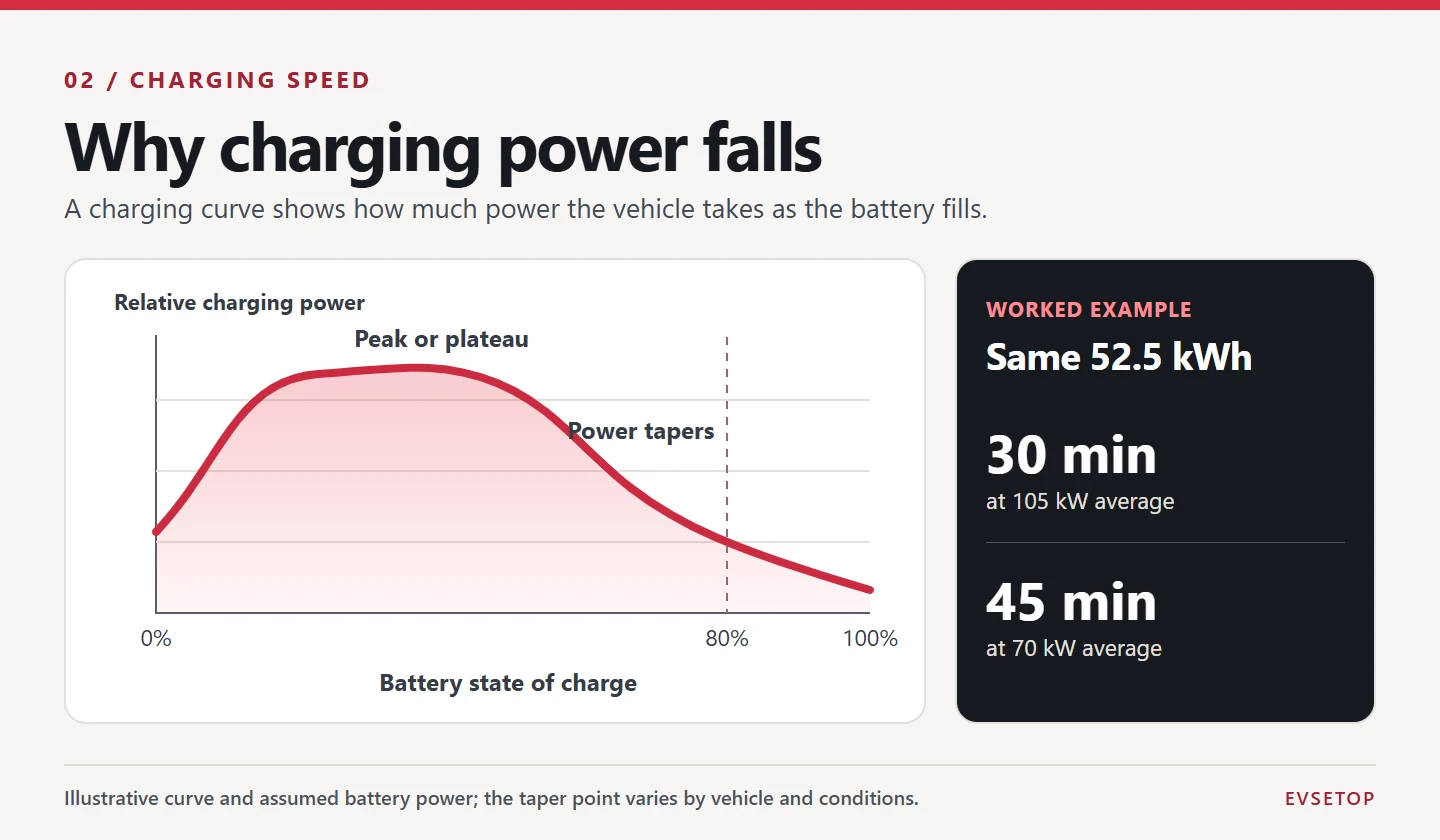
A 30-minute stop at a 150 kW charger
Take an EV with 75 kWh of usable battery capacity. Charging it from 10% to 80% adds about 52.5 kWh in this example (75 × 0.70). Divide 52.5 kWh by the average power reaching the battery to get the time in hours.
| Average battery-side power | Approximate time to add 52.5 kWh |
|---|---|
| 105 kW | 30 minutes |
| 70 kW | 45 minutes |
Both assumed averages are below the station’s 150 kW rating. The table uses power reaching the battery, so the calculation doesn’t need a separate adjustment for losses. Add time for any wait and for plugging in and starting the session.
The port’s current limit can also explain what you see on the display. At 400 V, a port capped at 300 A can deliver up to 120 kW at its DC output (400 × 300 ÷ 1,000), even if it can reach 150 kW at another voltage. If you’re comparing equipment, ask the supplier how much power and current the port can deliver at the battery voltages in your fleet.
Which Level 3 connectors work with your EV?
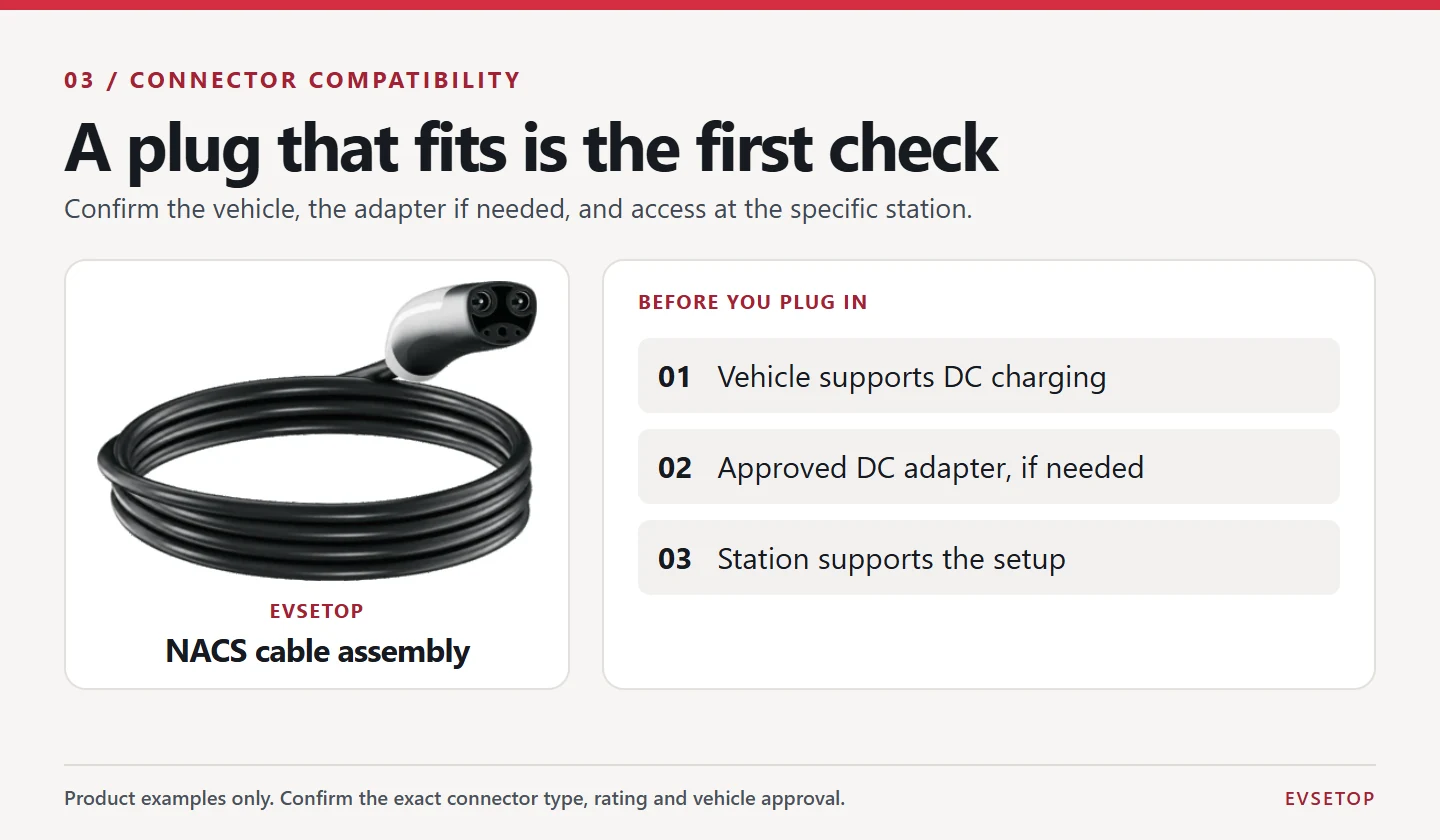
Before you pick a stop in the U.S., find out whether your car or light truck supports DC fast charging and which inlet it uses. If you need an adapter, use one your vehicle maker approves for DC charging and make sure the station supports that setup.
| Interface | What to check |
|---|---|
| CCS1 (Combo 1) | Confirm the vehicle has a CCS1 inlet or explicitly supports the approved DC adapter needed for the station. CCS2 is a different connector used in other markets. |
| NACS / SAE J3400 | The connector design can be used for AC or DC. Check that the site offers DC charging and that the operator supports your vehicle and access method. |
| CHAdeMO | Some older EVs use it. Check the station listing for an available CHAdeMO port; a CCS1 port does not directly serve a CHAdeMO inlet. |
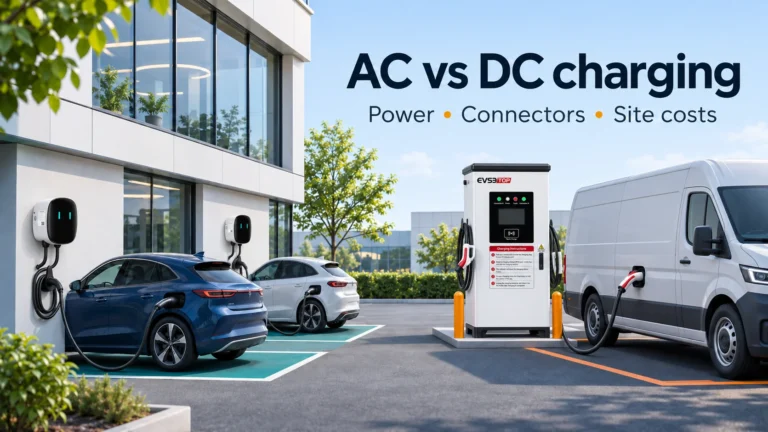
Check the model year when you make a fleet list. The inlet or DC charging support can differ between vehicles from the same maker. The Joint Office’s connector and adapter guide explains how to check compatibility. For connectors in other markets, see the AC vs. DC charging and connector guide.
Does Level 3 charging harm the battery?
Geotab’s fleet telematics analysis found greater average capacity loss among vehicles that used high-power DC charging more often. Battery design, temperature and driving patterns can affect capacity too. The study compared vehicles in regular use, so it can’t isolate the effect of a single fast charge or predict how much capacity your car will lose.
Follow the vehicle maker’s charging guidance. If your fleet parks long enough to recharge on AC, you can use DC for the vehicles that need to get back out sooner. Count how often that happens before buying more DC capacity.
What does Level 3 charging cost?
What drivers pay
At a hypothetical rate of $0.45 per kWh, a station that bills you for 40 kWh would charge $18 for energy before any separate fees or taxes. Use the amount on the bill for that calculation; your battery can gain a different amount. Electrify America’s pricing page shows how one U.S. network lists its rates. At the station, look for the rate that applies to you and any separate session or idle fees.
How much power does the site need?
Suppose two vehicles pull in together. Each needs 35 kWh at the battery, and both leave in 30 minutes. That’s 70 kW on average per vehicle, or 140 kW across both batteries. A cabinet capped at 120 kW of total DC output falls short even if each connector can handle a higher peak on its own. Even above 140 kW, the site has to supply the cabinet, and each vehicle has to accept enough power over those 30 minutes.
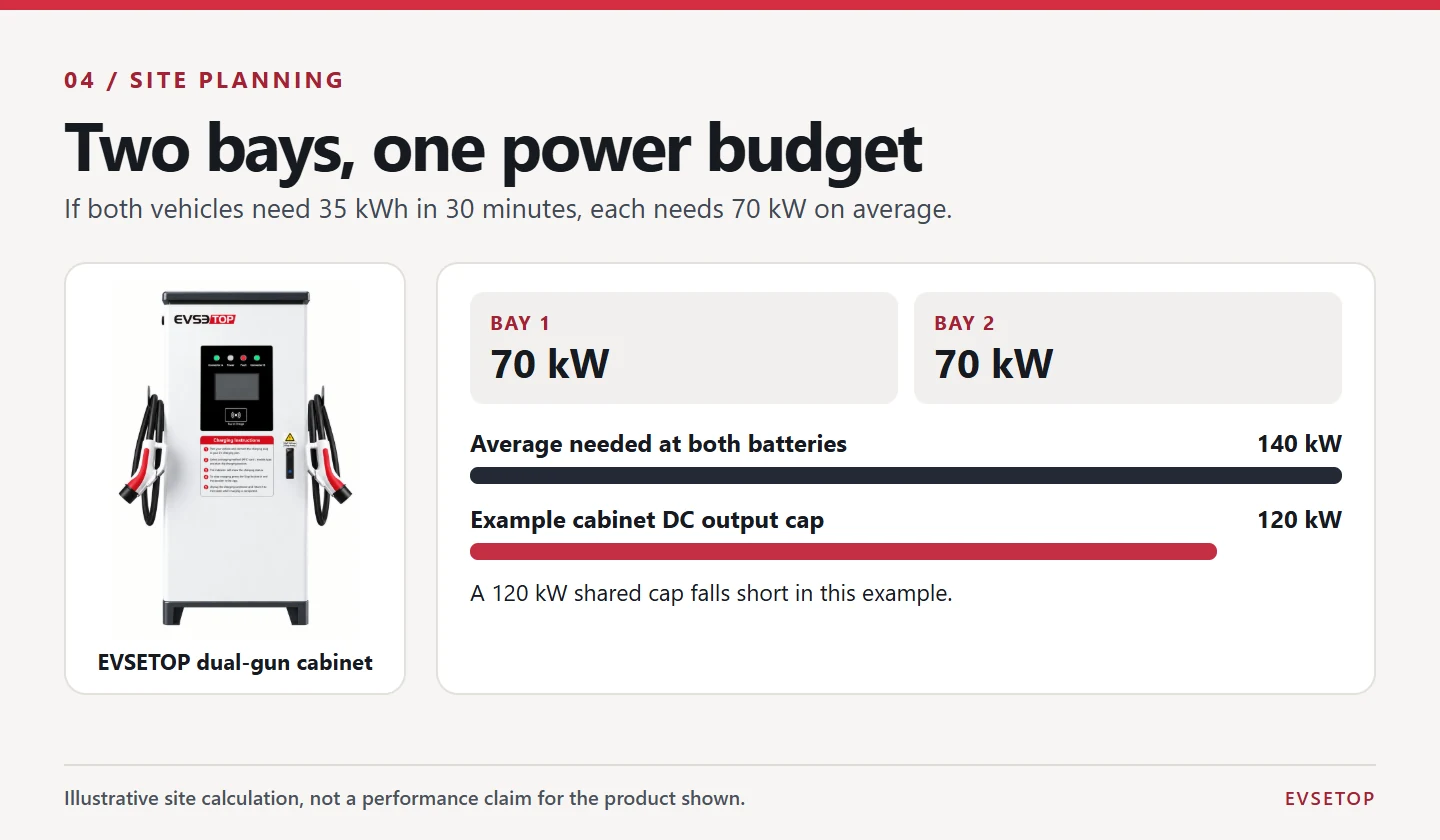
Ask the supplier for the total DC output and what each port gets with both bays occupied. If one car starts to taper, can the other use the power it frees up? Compare the answer with your arrival schedule. If the vehicles sit for hours, do the same calculation for AC before paying for DC.
The cabinet quote is one line in the budget. Include electrical and civil work, any utility upgrades, and the cost of electricity, network service and maintenance. If the utility bills for peak demand, ask how it measures that peak. The DOE procurement and installation guide covers those costs and when to involve the utility. Browse the EVSETOP DC fast charger range and ask for current data on the configuration you’re considering.
Frequently asked questions
Can you install a Level 3 charger at home?
Level 1 or Level 2 is usually the practical choice for a U.S. home, where the car may be parked overnight. Commercial DC equipment generally needs more from the electrical service. Whether you can install a particular unit depends on its input requirements and what the property can supply. If you’re looking at Level 2, start with the EPA’s home charging guidance and have a qualified electrician assess the site.
Is a Tesla Supercharger a Level 3 charger?
Yes. A Tesla Supercharger is a DC fast charger. Tesla also makes AC charging equipment. If you drive another make, check Tesla’s compatibility guidance for the site you plan to visit, your vehicle and any approved adapter you’ll need.
Does a station with two charging cables always charge two cars at once?
No. One port can have two different plugs and still charge just one car at a time. Two independent ports can serve two cars, though they may share a cabinet’s total output. Check how many sessions the station can run at once and what each car can get.
Is 80% the right place to stop every time?
If the power has started to taper and you can reach the next reliable charger with room to spare, it may be quicker to leave. If the next stop is a long way off, stay plugged in longer. Allow for the weather, your speed and the route, and follow the vehicle maker’s guidance.
Plan around the energy your vehicles need
Before you ask for a quote, write down what the busiest half hour or hour looks like. Which vehicles are plugged in together? How many kWh does each need before it leaves?
Discuss the required charging configuration with EVSETOP. Send that schedule along with the vehicle inlets and what you know about the site: target market, installation environment, system voltage, phase and power limit. Ask what each port can deliver at your vehicles’ battery voltages when the bays run together, and request the current documentation for that configuration.