When you compare EV charging station manufacturers, check what each bid covers. One DC quote may cover little more than the cabinet. Another bid for the same site might include payment software and someone to answer the phone when a driver can’t charge. Comparing those prices as if they cover the same work is an easy way to pick the wrong supplier.
For a roadside site, compare public DC equipment with a managed charging program. At a depot, look at how the chargers share power before vehicles are due out. Networked AC is a good starting point where cars park for hours. For private label, settle who controls the product and its software.
Compare 10 EV charging suppliers at a glance
We grouped these ten companies by what a buyer can compare, using their published offers. There are no scores for sales, pricing or field performance. EVSETOP publishes this guide and appears on the shortlist. The last column gives you a first question for each supplier; use the answer to check what they can actually quote in your market.
| Company | Published offer to evaluate | Where to start | First question for the supplier |
|---|---|---|---|
| ABB E-mobility | A400 integrated DC charger | Roadside or urban public charging | How much power reaches each vehicle when both outlets are active? |
| Alpitronic | Hypercharger HYC family | Public DC charging with a choice of cabinet formats | Which HYC model and cable configuration can I order in this market? |
| Tesla | Supercharger for Business | Site owners comparing a managed fast charging program | Who controls pricing, data, driver support, and service? |
| ChargePoint | CP6000 AC and Express Plus DC | Operators comparing hardware and network software | Which functions are included with the proposed software and service plan? |
| Siemens | SICHARGE D | DC projects with a separate electrical contractor | Where does charger commissioning end and the EPC’s scope begin? |
| Kempower | Distributed Power Unit and Satellite dispensers | Depots with several vehicles on a shared supply | How does the system allocate power when multiple vehicles are due out together? |
| Delta Electronics | UFC 200 DC | Commercial DC sites benchmarking a cabinet quote | What work and replacement parts are available through the local service channel? |
| Schneider Electric | EVlink Pro AC and EcoStruxure EV Charging Expert | Building car parks that share capacity with other loads | Which meter, controller, and licenses are needed to enforce the building’s power limit? |
| Wallbox | Pulsar Pro shared AC charger | Workplaces and multifamily parking | How will users authenticate, and what happens if connectivity drops? |
| EVSETOP | AC wallbox and DC ranges; OEM/ODM inquiry | Distributors or integrators defining a regional offer | Which branding and engineering changes are in scope, and what documentation covers the finished unit? |
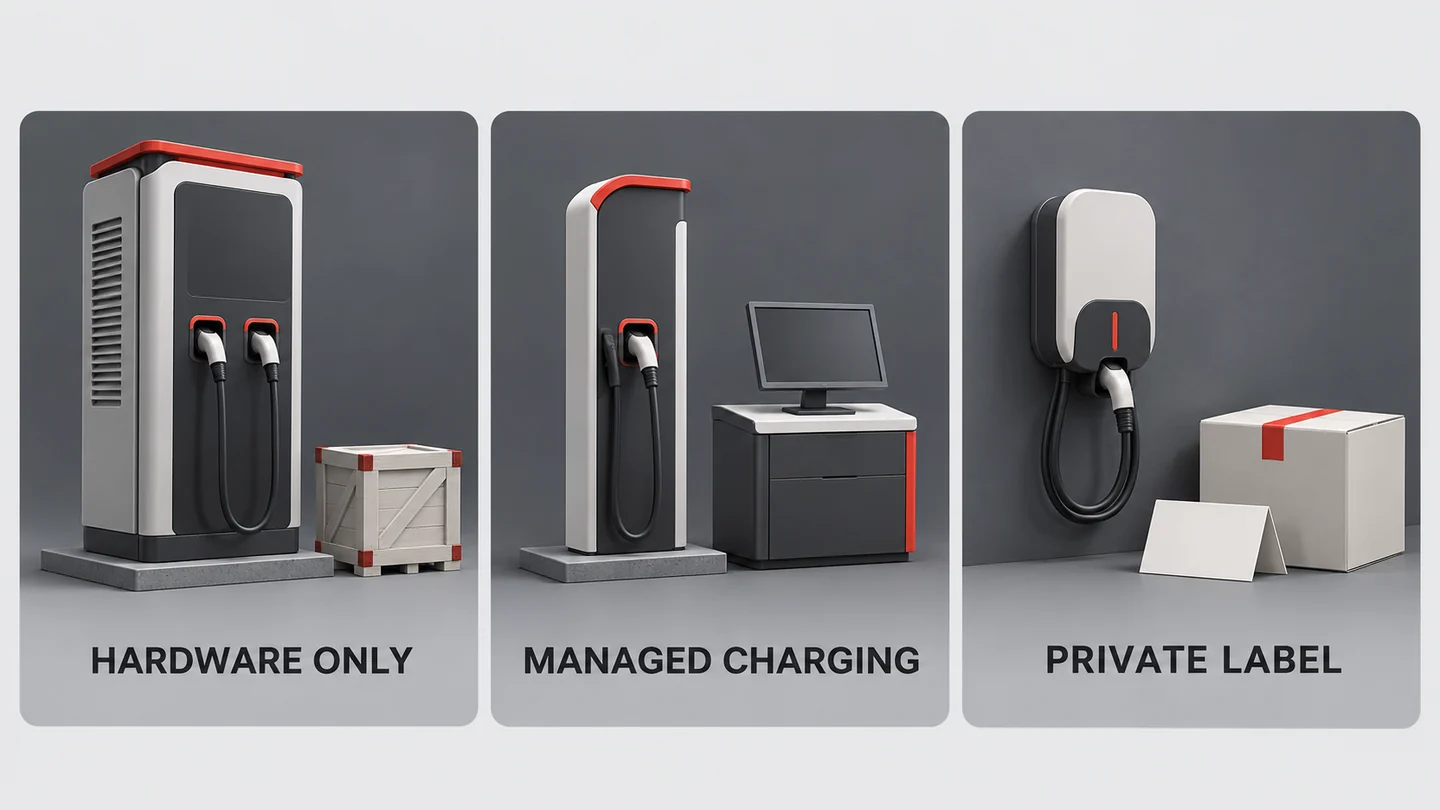
Public and corridor charging: decide who operates the site
Picture a driver pulling in at 9 p.m. The charger is on, but the payment won’t go through. Whose number is on the screen? Settle that when you compare public charging bids, particularly if one company supplies the hardware and another runs the network.
ABB E-mobility
ABB’s A400 puts two DC outlets on one cabinet and shares power between them. That’s a useful option when there’s little room for equipment. For the quote, have ABB show what a lower-voltage vehicle can draw while the second outlet is busy. Find out who repairs the cabinet locally.
Alpitronic
Alpitronic’s Hypercharger range includes all-in-one HYC cabinets as well as a distributed system. If two cabinet sizes look plausible, mark the parking bays and service clearances on a site plan. Will the cables reach where you need them? Compare output at the voltages your vehicles use and confirm which model is available locally.
Tesla
Tesla’s Supercharger for Business bundles hardware, software and service. Tesla also lists a white-label option. If the package fits your operating model, check which vehicles the proposed setup serves, what you still need to install and maintain, and which data and pricing controls you keep. Those details matter when you put it beside a hardware-only bid.
ChargePoint
ChargePoint has a CP6000 commercial AC station and Express Plus DC fast charging. It’s a candidate if you want to compare chargers and station management together. Check whether the proposed plan covers the access, payment and reporting each site needs, then compare software and service fees over the same number of years.
Depots and commercial DC: buy for the busiest charging window
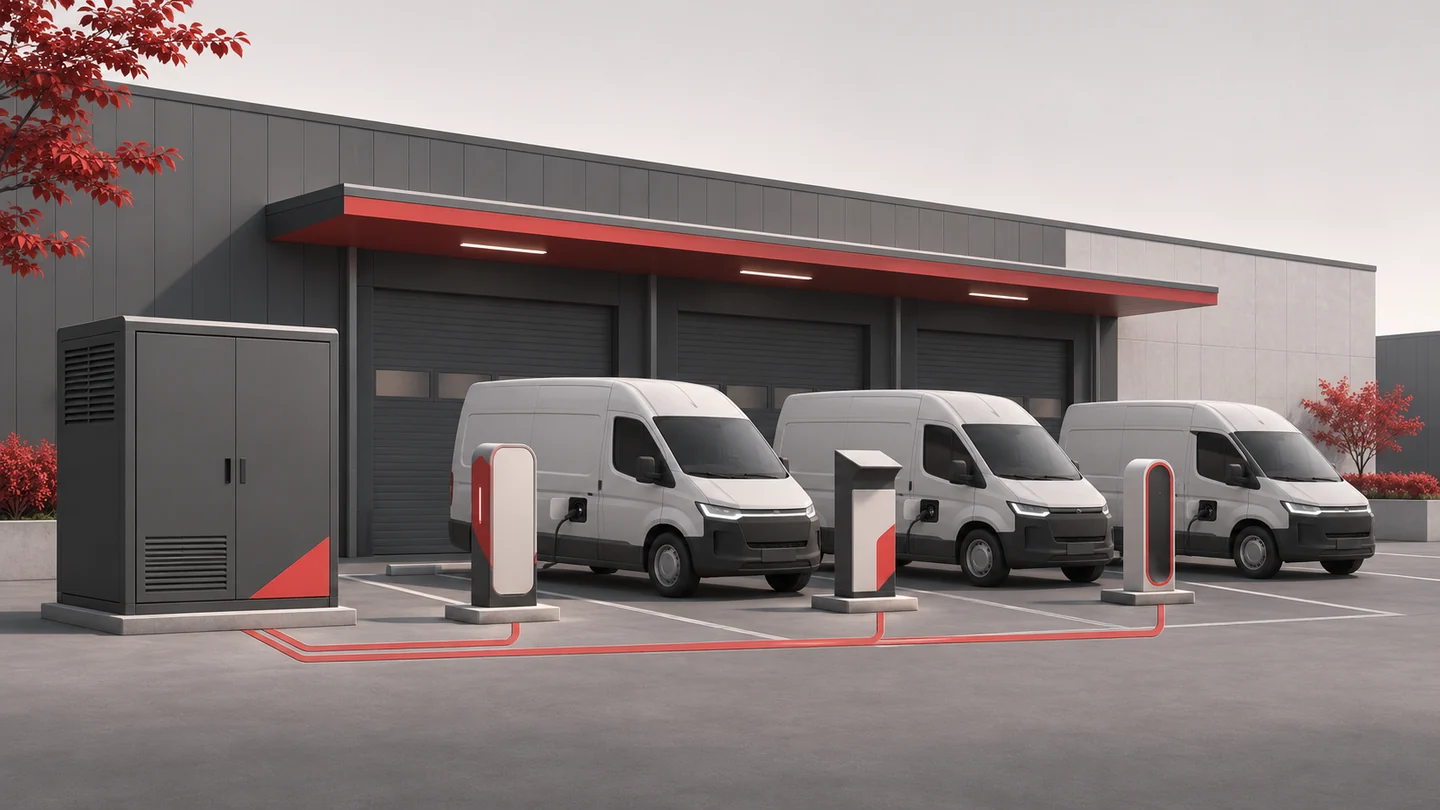
The fleet might need less energy than the depot can deliver overnight. That won’t help the van that gets back late and leaves before dawn. Give every bidder the same arrival and departure schedule, vehicle energy needs and site power cap. For public DC charging with short stays, use the busiest part of a typical day.
Siemens
Siemens documents dynamic power allocation between DC charge points in the SICHARGE D manual. If an EPC is running the project, put the charger supplier and electrical contractor in the same scope review. Someone needs to own the site controls and communications as well as the installation checks and final commissioning.
Kempower
Kempower’s distributed charging system separates the power cabinet from the Satellite dispensers. That gives you more flexibility in where the cabinet goes. Ask the supplier to walk through what happens when a late van needs priority. If you’ll add bays next year, ask what equipment the first phase would need to accommodate them.
Delta Electronics
Delta Electronics’ UFC 200 gives you another commercial DC cabinet to price. Request the regional datasheet and quote it against the same vehicle mix as the other options. Before comparing totals, check what’s included for commissioning and who can supply a replacement module or cable where the charger will operate.
Workplace and destination charging: check the building’s power limit
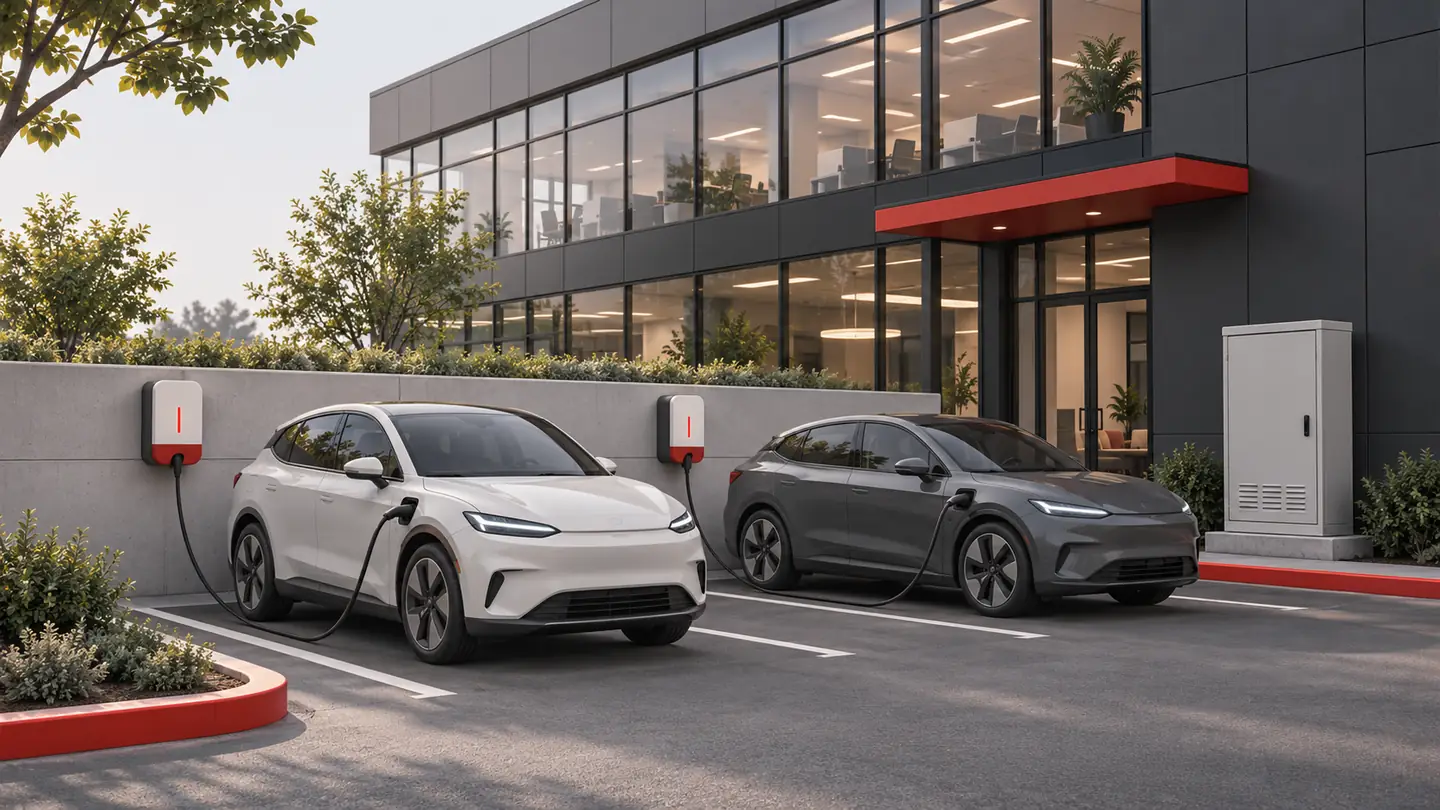
If cars stay parked through a work shift, work backward from the energy they need before they leave. Start with Level 2 AC in North America or the applicable local AC configuration elsewhere. Size the proposal for a full car park at the same time the building is busy.
Schneider Electric
Schneider Electric pairs EVlink Pro AC and EcoStruxure EV Charging Expert for building charging and load management. On a retrofit, start by asking which meters and controls you can keep. Have the electrical team set a charging cap and test what the chargers do if they stop hearing from a meter or controller.
Wallbox
Pulsar Pro is Wallbox’s shared AC option for places such as offices and apartment buildings. Get the regional model code and have the supplier show how staff or residents start a charge. Put recurring connectivity fees in the budget.
Private-label procurement: define exactly what changes
A logo change and a cable change can have very different consequences. Give bidders a marked-up list of what you want changed from the base model. Have them flag anything that changes the order code, requires new testing or paperwork, or affects who supports the product later.
EVSETOP
At EVSETOP, we list AC wallboxes and DC fast chargers. The OEM/ODM inquiry page separates private labeling from hardware changes and design work. Bring the proposed destination market and a list of changes so the quote can specify what’s in scope, who approves firmware updates and which documents apply to the branded unit.
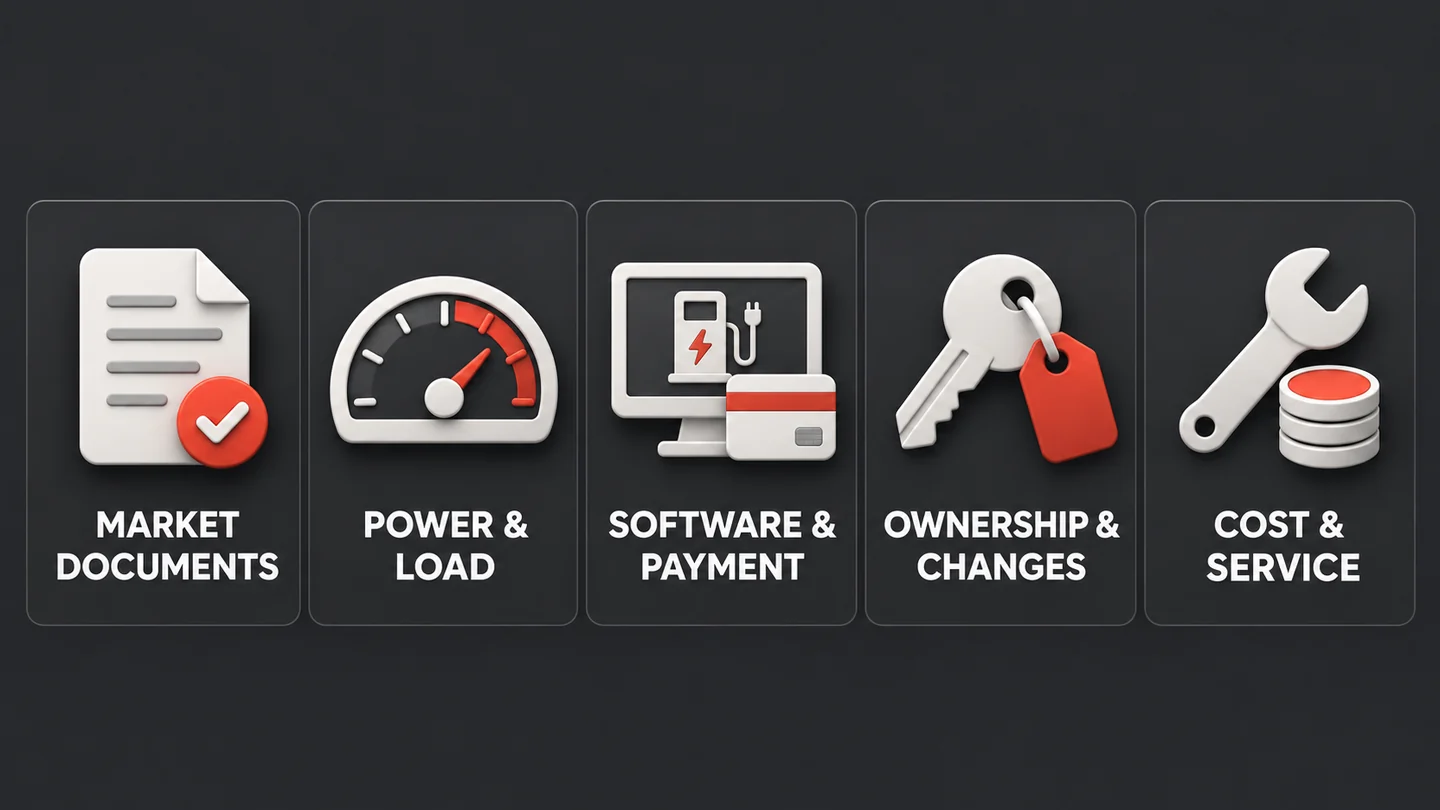
Five checks to put in every supplier RFQ
Send the same request for quotation (RFQ) to the two or three suppliers you’d consider buying from. For each item, say what evidence you’ll accept. A catalog can tell you a charger supports a feature; a test on your backend can tell you whether it works the way your site needs it to.
- Market documents. Ask for the exact order code, nameplate, and documents that cover that unit. Check the European Commission’s CE guidance for the EU, the UK’s marking rules for Great Britain, and the certification record where a recognized testing laboratory is required in the U.S.
- Output and load control. Have the supplier show what each port delivers at the vehicles’ battery voltages when the expected number of bays is in use. Get the total cabinet rating and the per-port limits separately. For dynamic load management, check which meter it reads and what power cap applies if the controller goes offline.
- Software and payment. Specify the charger management system (CSMS), firmware, and version of OCPP. Ask for a demo on your intended backend: start a session, enforce a power limit, recover after a network outage, and export the transaction. Verify the required payment flow separately.
- Ownership and changes. If you switch backend or distributor, can you take your transaction data and charger credentials with you? Put account ownership and responsibility for software updates in writing. If the project changes the hardware or branding, name who maintains the compliance file for the finished unit.
- Cost and service. Request separate lines for equipment, installation and commissioning, network fees, and ongoing service. Ask who keeps spares, handles first response, and pays for labor and shipping during warranty repairs. See the detailed manufacturer evaluation guide for document and pilot checks.
Say you’re pricing six roadside bays. One quote includes driver support; the other ends at the hardware. Compare six usable bays over the same term, adding the payment, networking and maintenance contracts you’d have to buy separately. Then run through a failed payment with both bidders. Who gets the alert, who can get the bay working again, and who pays if a technician has to go out?
Three questions to resolve for 2027 projects
A charger that fits the site plan can still be wrong for the vehicles, the operator’s software or the local payment rules. Check all three against the exact configuration before the supplier prices it.
- Which connectors and cooling options matter? For North American DC sites, survey how many vehicles use CCS1 versus SAE J3400 (NACS). Verify actual vehicle and station compatibility using the Joint Office connector guide. If a DC offer uses a liquid-cooled cable, ask what continuous current is available under your site conditions. Evaluate Megawatt Charging System (MCS) separately for compatible heavy-duty vehicles and a schedule that needs it.
- Will the backend and vehicle features work together? OCPP 1.6J is the JSON implementation of OCPP 1.6. The Open Charge Alliance explains that 1.6 and 2.0.1 are not compatible with each other. Verify the common version and certification scope if claimed, then test the functions you need. ISO 15118 Plug & Charge is a separate vehicle-facing capability; include it in acceptance tests if it is part of the offer.
- Can an occasional driver pay without an account? In the EU, AFIR Article 5 extends card-reader or card-capable contactless payment requirements from January 1, 2027 to publicly accessible charging points rated 50 kW or more on the TEN-T road network or in safe and secure parking areas, including older points. The provision exempts points where charging is free. Confirm the scope for your site and test payment from the driver’s side.
Frequently asked questions
Who are the top EV charging station manufacturers for commercial projects?
For public DC hardware, ABB E-mobility and Alpitronic are starting points. Tesla is an option for managed fast charging, and Kempower is worth comparing for distributed depot DC. For shared commercial AC, look at ChargePoint, Schneider Electric or Wallbox. Narrow the list based on what you can buy and service locally and what documentation comes with it.
How much does a commercial EV charging station cost?
Request a site-specific installed quote. Price equipment, design, utility or service upgrades, trenching and installation, and commissioning separately from electricity, network fees, and maintenance. For U.S. projects, the Department of Energy procurement guide explains which site and operating factors to include.
Does OCPP support mean I can switch software providers?
It helps, but you still need to verify the version, firmware, and functions on the new backend. Check whether you can change the endpoint, obtain the required credentials, export data, and keep the payment and load-management features your site depends on.
Can I buy white-label EV chargers from a Chinese supplier?
Yes, if the supplier offers the required configuration and the finished product can meet the rules in your destination market. Agree on who holds the applicable documentation, who handles product changes and updates, and who supplies spares and warranty service. Review a production-equivalent sample before ordering volume.
Request a quote for your actual charging configuration
Send your charging brief to EVSETOP. Include the country, vehicle inlets, site power limit and how many bays will charge at once. A bay layout helps with cable reach, and a charging schedule shows how much energy you need and by when. Include any backend, payment or branding requirements, and request the current datasheet and documents for the quoted configuration.